| Status: | Active, open to new members |
| Leader: |
Neil M
|
| When: | Fortnightly on Thursdays 2:30 pm-4:00 pm (Max. Group size: 25) Starts April 30, 2026. |
| Venue: | Moordown Community Centre |
We will look at the evolution and development of early Humankind from the very beginning down to the Early Civilisations, and possibly later,
concentrating on Humankind’s spiritual journey, and the differences between ancient religious beliefs and superstition.
Alternate weeks, the Summer term starting on April 30.
In a little more detail ...
The central theme of these talks is spiritual evolution.
They will discuss how (and why) did religion and religious belief develop in early Homo Sapiens? They will ask how this belief matured and impacted on the development of human comprehension, culture, and ultimately civilization? They will consider what is religious belief (in its broadest sense) as opposed to superstition?
Across millions of years, these talks will try to trace the development of humankind’s intelligence, but always with an emphasis on the evolution of humankind’s spiritual awareness.
Over a very long period of time, how did this spiritual awareness develop into religious frameworks. And always noting that there were social, political, and technological evolutions taking place at the same time, and interacting with these religious developments.
As the Neolithic period progressed from around 10,000 BCE, the evidence suggests that religious frameworks appeared to morph into disciplined state religions dominated by ‘High Gods’, high priests, kings, and politics. Do these state religions differ from blind superstition
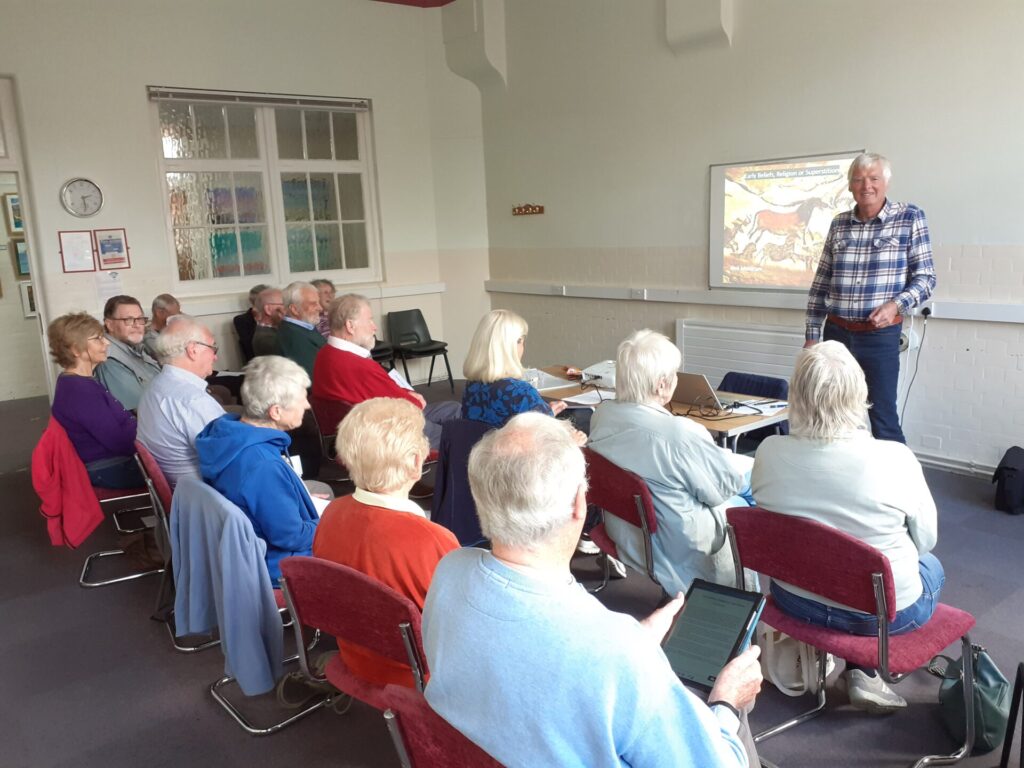
The talks will examine what is often called the ‘Axial Age’, a period from about 800 to about 200 BCE.
It has been contended that during this period, in various contemporaneous societies, religious outlook and practice changed radically with a changing political and social landscape. Did humankind, whether collectively or individually, acquire a greater understanding of its own spirituality? And, if so, how was this spirituality reconciled with the cosmos, politics and an increasingly complex social environment?
The talks will conclude by looking at the roots and the early phases of the so-called world religions, and the accompanying social and cultural conditions leading to these world religions. And again, how did all these developments differ from superstition in its very widest sense?
With a concentration on history (in so far as one can), these talks aim to be as balanced and as objective as possible.
In summary, these talks will suggest how and why the past shapes all our lives.